Backpacking base weight: what it is and how to calculate it
Base weight is the weight of your pack and everything in it, minus consumables (food, water, fuel) and minus what you wear. Backpackers compare it because it stays the same from one trip to the next. To calculate it, weigh every item, add up what rides in the pack, and leave out food, water and fuel.
The weights backpackers talk about
- Base weight
- The pack and everything in it that you don’t use up: shelter, sleep system, kitchen, carried clothing, first aid, electronics. It only changes when your gear changes.
- Worn weight
- What is on your body while you walk: shoes, socks, hiking clothes, hat, sunglasses. Conventions vary for trekking poles and what is in your pockets; pick one and keep it.
- Consumables
- What gets used up during the trip: food, water, stove fuel and, to be precise, sunscreen and toilet paper. They weigh the most on the first morning.
- Total pack weight
- Base weight plus consumables: what the pack weighs when you lift it at the trailhead.
- Skin-out weight
- Total pack weight plus worn weight: everything you carry, from your skin outward.
How to calculate your base weight
- List every item you take, with its quantity. The backpacking checklist makes a good starting list.
- Weigh each item on its own, with its stuff sack if you carry it in one.
- Mark each line as worn, consumable, or neither.
- Add up everything that is neither worn nor consumable: that sum is your base weight.
- Add this trip’s consumables to get your total pack weight.
In one line: base weight = total pack weight − consumables, with worn items never counted in the pack.
A worked example
| Grams | Pounds | |
|---|---|---|
| Shelter (tent, stakes) | 1,050 g | 2.3 lb |
| Sleep system (quilt, pad, pillow) | 1,400 g | 3.1 lb |
| Pack and liner | 900 g | 2.0 lb |
| Carried clothing | 900 g | 2.0 lb |
| Kitchen and water treatment | 600 g | 1.3 lb |
| Navigation, safety and first aid | 400 g | 0.9 lb |
| Hygiene and small items | 300 g | 0.7 lb |
| Base weight | 5,550 g | 12.2 lb |
| Food (2 days) and fuel | 1,600 g | 3.5 lb |
| Water (1.5 liters) | 1,500 g | 3.3 lb |
| Total pack weight | 8,650 g | 19.1 lb |
| Worn clothing and shoes | 1,300 g | 2.9 lb |
| Skin-out weight | 9,950 g | 21.9 lb |
With a 5.55 kg (12.2 lb) base weight, this kit sits in the lightweight range below. Food, fuel and water add 3.1 kg (6.8 lb) on the first morning, and a little less every day after that.
Base weight benchmarks
There is no official scale, but these thresholds are the conventions most backpackers use. They come from the US ultralight community, hence the round numbers in pounds:
| Category | Base weight | In kilograms |
|---|---|---|
| Traditional | over 20 lb | over 9 kg |
| Lightweight | 10 to 20 lb | 4.5 to 9 kg |
| Ultralight (UL) | under 10 lb | under 4.5 kg |
| Super ultralight (SUL) | under 5 lb | under 2.3 kg |
Treat them as reference points, not goals. A sensible base weight depends on the season, the terrain and your experience: a pack that is ultralight in summer can become a risky one on a cold, wet night in the mountains.
Where the grams usually hide
- The big three. Shelter, sleep system and pack often make up half the base weight or more: this is where one change saves the most.
- Stuff sacks, pouches and packaging. A few dozen grams each, and there are many of them.
- Duplicates. Two knives, two lights, a spare of everything “just in case”.
- Extra clothes. A full change of clothes that never gets worn; a dry sleep layer is usually enough.
- Full-size toiletries and an oversized first aid kit. Repackage into small containers, and keep what you know how to use.
- Electronics. Power banks, cables, chargers and their cases add up quickly.
- Water and food beyond what the trip needs. One liter of water weighs 1 kg (2.2 lb): carry it for the dry stretches, not for the whole day.
The quickest win is often what you carried and never used. Note it after each trip, and decide before the next one.
How to weigh your gear
- A kitchen scale that reads to the gram (or 0.1 oz) is enough for nearly every item; use a luggage scale for the packed bag.
- Weigh items yourself rather than trusting the listed weight, which often leaves out stakes, stuff sacks or straps.
- Weigh things the way you carry them: the tent with its stakes, the stove inside its pot if they travel together.
- Weigh partly used fuel canisters before each trip to know how much gas is left.
- Write each weight down once. A gear list is only as good as its weights.
How GearPulse adds up your pack weight
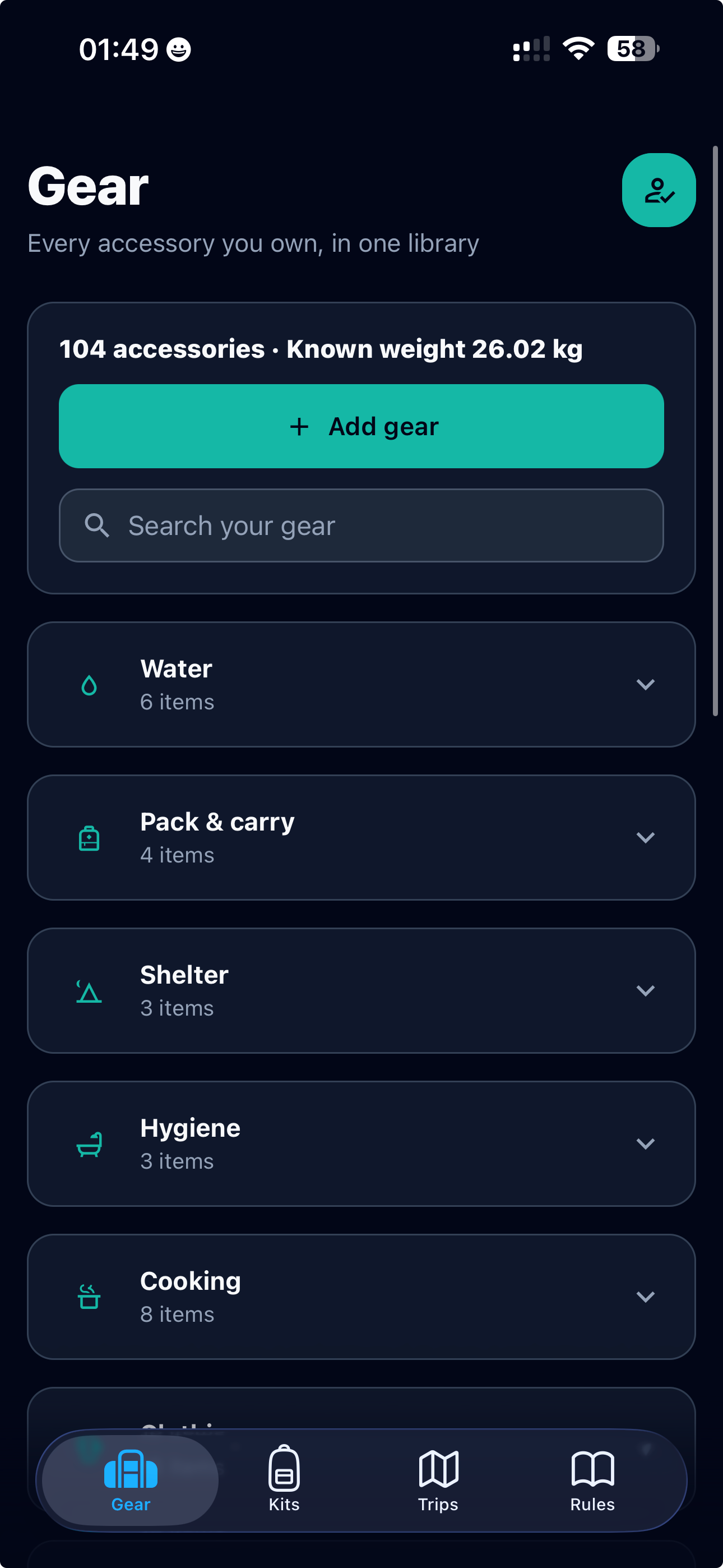
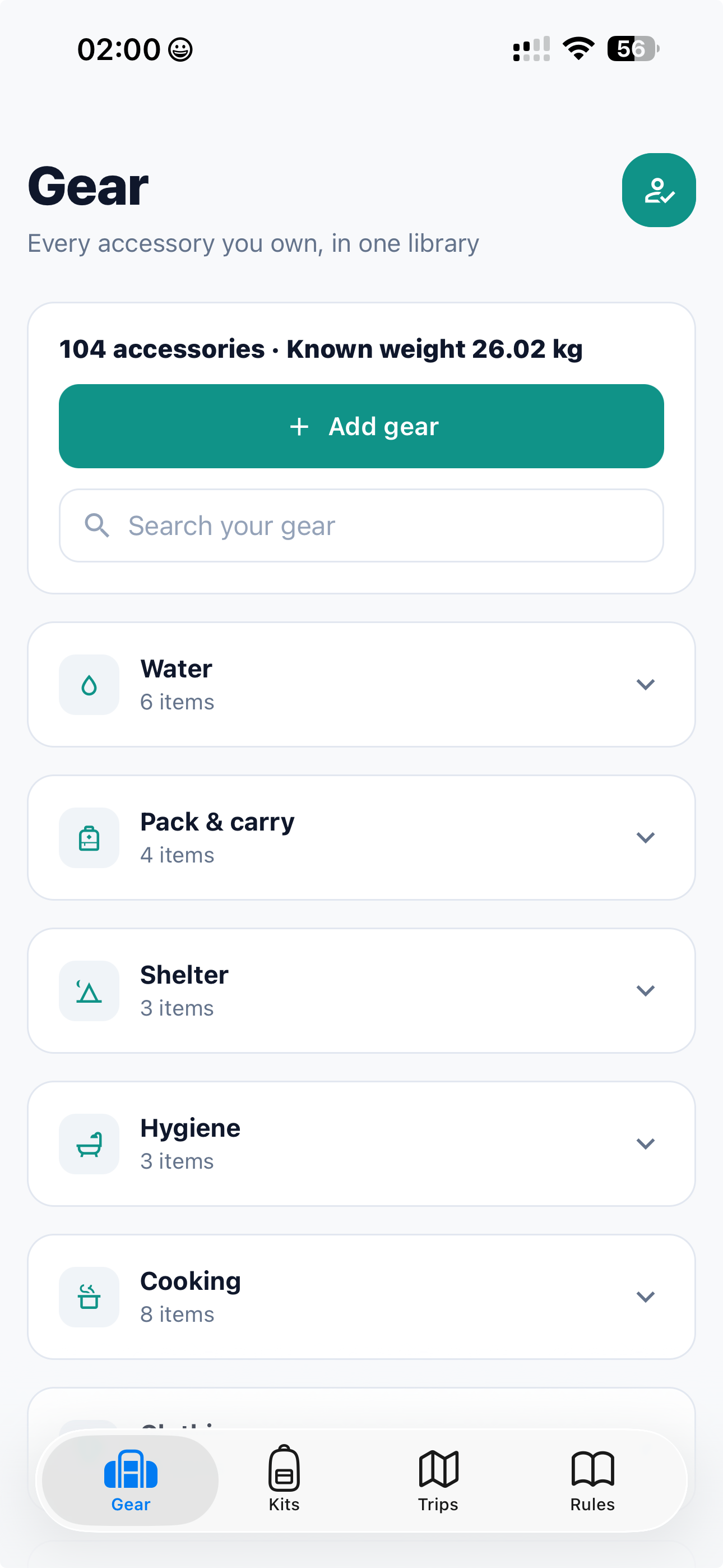
GearPulse, the free iPhone app for hikers, keeps the weight of every item you own, in grams, with its quantity.
- Mark an item “Worn on you” to keep it outside the bag’s weight, or “Consumable” for food and fuel, with optional calories per unit.
- Each kit shows its weight in the bag, how much of it is consumables, and what you wear on top: your base weight is the bag weight minus consumables, at a glance.
- A bar shows the kit’s weight by category, with each category’s share, so you see where the weight goes.
- Items without a weight are flagged and left out of the total, never guessed.
- Each item shows how often it went unused, and the weight you would save by leaving it at home.
- When you pack for an outing, the weight in the bag updates as you tick items off, with consumables and calories per day.
- A kit published as a public page (with an account) shows its total weight, base weight and consumables, to share with a link.
Weights come from your own scale. A photo scan can suggest one, marked as to be checked; a missing weight is never filled in for you. For the list itself, start from the backpacking checklist.